Launch Story
Why I built Veil: the white noise app
I couldn't find anywhere.
I've been a light sleeper my entire life. Falling asleep has always been a process, and staying asleep is even harder. I live in New York City, where the sounds never stop: car horns at 2am, garbage trucks at 5am, neighbors who apparently rearrange furniture at midnight. Even with the windows closed, the city finds a way in.
In the summer, my window AC unit actually does a pretty great job as a noise machine. That constant drone masks everything. But the rest of the year? I'm on my own. So over the years I've tried everything: apps, physical sound machines, YouTube videos on loop, a literal box fan pointed at the wall. Some of it worked. None of it was quite right.
As someone who's spent years relying on these tools, and who also happens to have a background in software engineering, I eventually decided to stop searching and start building. The result is Veil, now live on both the iOS App Store and Google Play.
This is the story of why I made it and what I think everyone else is getting wrong.
Want to hear it first? Every noise color plays free in your browser, from the same generators the app runs.
The noise machine problem
I started with a Dohm, the classic white noise machine that everyone recommends. And the sound is genuinely good. It's a real fan inside a housing, so the noise is organic and non-repeating. But it just doesn't get loud enough. In an NYC apartment with thin walls, the Dohm couldn't mask a car horn or a slamming door down the hall. I turned it up to max and it still wasn't enough.
Then there's the portability issue. The Dohm is the size of a small cantaloupe. You're not throwing it in a carry-on for a work trip or a weekend away. You either commit to bringing it and losing bag space, or you go without it and sleep terribly in a hotel room.
So I tried a Lectrofan. Better volume, electronic sound generation (no actual fan), more sound options. Checks most of the boxes for home use. But the interface is painful. You cycle through sounds one at a time with a button on top. Want to compare sound 3 and sound 8? Press the button five times. Want to go back? Cycle through all of them again. It feels like a device from 2005 because it basically is.
The Lectrofan is slightly more portable than the Dohm, but it's still a separate device you have to pack, find an outlet for, and remember to bring. And both of them cost around $50 for what is a pretty trivial gadget. You already have a powerful computer with a speaker in your pocket.
That said, both of these machines do one thing really well that most apps don't: they generate sound, they don't play recordings. The Lectrofan synthesizes its sounds electronically. The Dohm uses a physical fan. Neither of them loop an audio file. That matters more than you'd think, and it's the key insight that led me to build Veil.
The white noise app problem
I'm primarily an Android user, and the white noise apps on the Play Store are rough. Most of them look like they were designed a decade ago. They crash in the middle of the night, which is about the worst thing a sleep app can do. They use looped audio files where you can hear the restart if you listen for it. They're bloated with ads that cover the play button. And somehow they still want $40-60 a year for what is fundamentally a very simple utility.
iOS is slightly better, but the same core problems exist. The big-name sleep apps (Calm, Headspace) have white noise buried in a meditation app you don't need. The dedicated noise apps either loop, charge a subscription, or both.
The thing that kept bothering me: the Lectrofan proves you can generate noise electronically and it sounds great. Why isn't any app doing this properly? Your phone has more processing power than a Lectrofan by orders of magnitude. The digital synthesis that makes hardware machines sound good is just math, and phones are very good at math.
What I built
Veil generates every sound mathematically in real time. White noise is true random samples. Pink noise uses a cascaded integrator algorithm that produces the natural 1/f power spectrum. Brown noise uses a leaky integrator modeling Brownian motion. Fan sounds combine filtered broadband noise with low-frequency oscillators for the mechanical pulse.
There is no audio file. There is no loop. The sound is unique every second, all night, every night. This is the same fundamental approach the Lectrofan uses, just running on your phone instead of a $50 device you have to pack separately.
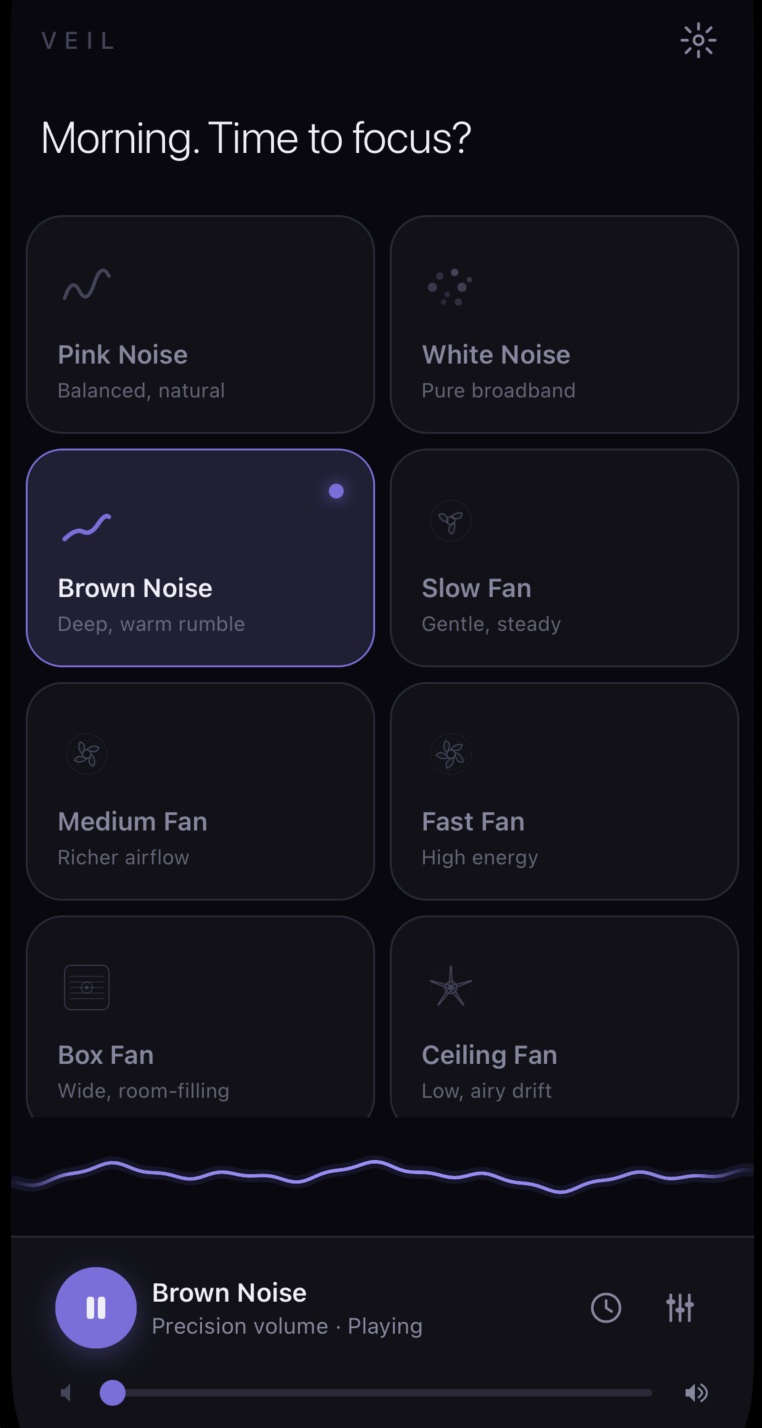
The Veil home screen. Dark mode only, one tap to play.
Beyond the synthesis, I focused on the things that frustrated me about everything else:
- Dark mode only. This is a sleep app. Nobody wants a white screen at 2am.
- One tap to play. Open the app, tap a sound, it plays. No onboarding, no account, no tutorial.
- Mix up to three sounds. Brown noise plus a slow fan plus a dryer? Layer them with independent volume controls and save the mix.
- Sleep timer that fades. When the timer ends, the audio fades out gradually instead of cutting to silence. No jarring wake-up.
- Siri Shortcuts. "Hey Siri, play Brown Noise" from your pillow without touching your phone.
- Lock screen controls. Play, pause, and stop from the lock screen. The app keeps playing through screen lock and backgrounding.
- $19.99 once, or subscribe if you'd rather. Four sounds are completely free with no limits. Premium unlocks all 23 sounds and mixing, for $1.99 a month, $9.99 a year, or $19.99 once. Buy it once and it's yours.
How it compares
Hardware
Dohm / Lectrofan
$45-55 one time
- ✓ Non-looping sound
- ✓ Good sound quality
- ✗ Not portable
- ✗ No mixing
- ✗ No timer with fade
- ✗ No voice control
- ✗ Dated interface
Veil
Veil
Free / $19.99 once
- ✓ Non-looping sound
- ✓ 12 synthesized sounds
- ✓ Always in your pocket
- ✓ Mix up to 3 sounds
- ✓ Timer with gradual fade
- ✓ Siri Shortcuts
- ✓ Dark, modern UI
Other Apps
Calm, Noisli, etc.
$40-70/year
- ✗ Loops audio files
- ✗ Bloated features
- ✓ Portable
- ✓ Some mixing
- ✗ Timer cuts abruptly
- ✗ Limited voice control
- ✗ Subscription required
Why you can still just buy it
Veil launched with one price and one plan: pay once, own it. I still think that's the right default for a utility. Veil generates noise. That's the product. There's no content to update, no server to maintain, no streaming cost, no library to curate. Charging you $60 every year for math that runs on your own phone is a hard thing to defend.
What I got wrong was assuming everyone wants to commit up front. People kept opening the purchase screen and closing it again, and honestly that's fair: you have no idea yet whether a sleep app is going to work for you. So there are monthly and annual plans now, as a way in for anyone who wants to try it properly before deciding.
The one-time unlock stayed, and it's staying. Almost every competitor will only rent you access. Veil is the one where you can pay once and never think about it again.
Four sounds are free forever: white, pink, brown noise, and a slow fan. No trial period, no "3 days free then we charge you," no limits on how long you can listen. If those four sounds are all you need, you never pay anything.
Premium unlocks the full library (23 sounds), mixing, saved presets, and Siri Shortcuts. $1.99 a month, $9.99 a year, or $19.99 once and it's yours. That's it.
Where you can get it
Veil is live on both the iOS App Store and Google Play. Download it free on your iPhone or Android device.
Download Veil
Free to try. 4 sounds, no limits. No account, no setup. Playing in seconds.
If you've been through the same frustration with noise machines and apps, I'd love to hear what you think. And if there's a sound you wish existed that doesn't, let me know. I'm one person building this, and every feature request goes straight to the top of the list.
You can reach me at support@veilsleep.app or find Veil at veilsleep.app. More about me and the other things I build is at colinhanson.dev.